
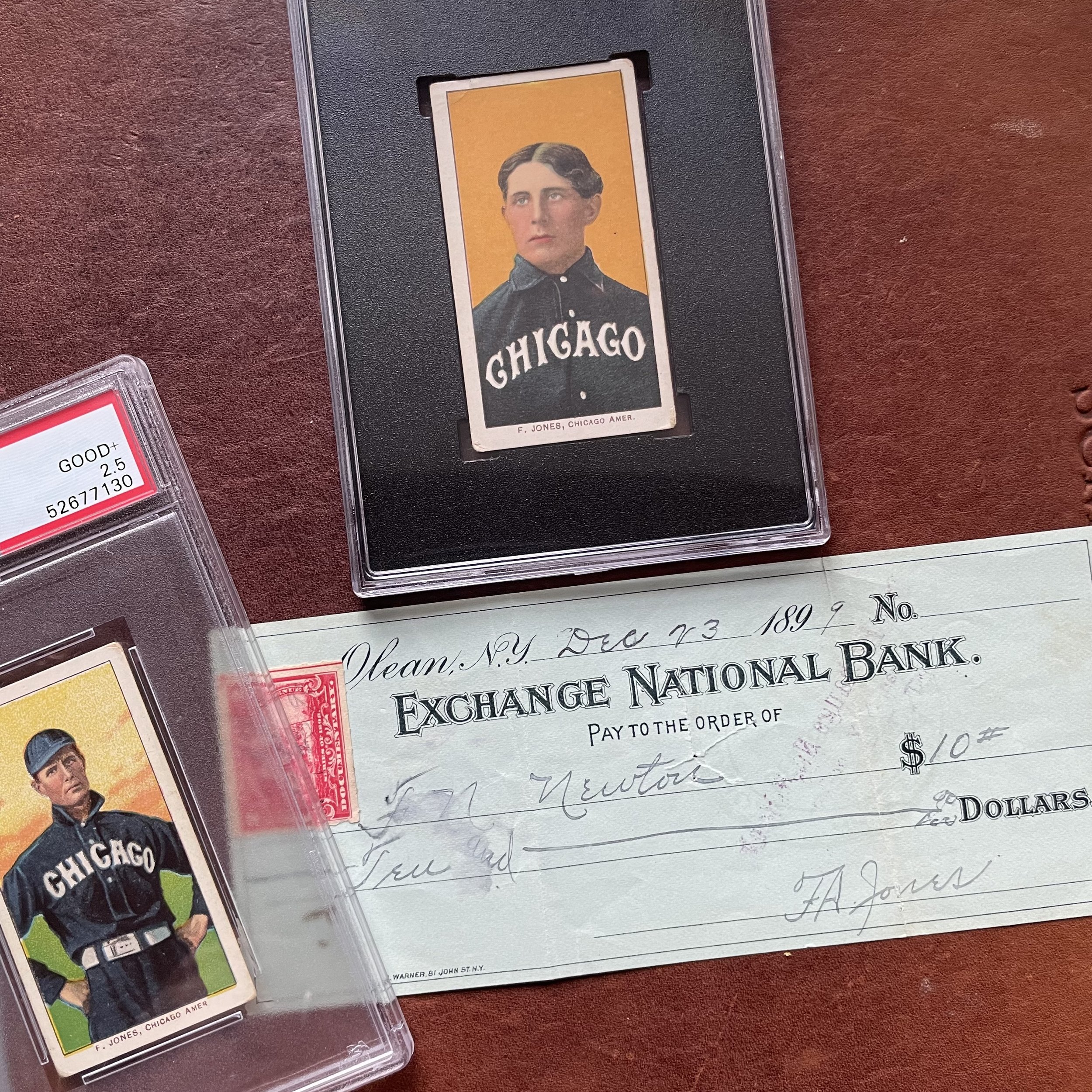
Fielder Allison Jones had two T206 cards in the 1909-11 tobacco card set. These cards are shown with a check signed by him on December 23, 1899.
10 years before his first T206 card was printed, Fielder Allison Jones was the star center fielder for the 1899 Brooklyn Superbas (now the Dodgers), which team won 101 games en route to the National League pennant. That year, the world was preparing for the Fin de Siècle (End of the Century). New Year’s Eve 1899 was the end of the 1800s, and the celebration parties were legendary.
Among those preparing for the grand event was Fielder Jones. Today, he is remembered as the tactical genius who managed the 1906 Chicago White Sox “Hitless Wonders” to a World Series title that remains one of the biggest championship upsets history. But, Jones also was a sharp-eyed businessman with deep roots in the New York-Pennsylvania border region. In 1898, Jones had married Mabel Schaney and began running a general store in Bolivar, NY, just across the state line (and about 10 miles away) from Shinglehouse, PA, where he was born in 1871. When the bats and gloves were put away for the winter, Jones returned to Bolivar to run his general store. By late December, the baseball season was long over, and Jones was fully immersed in his “civilian” life as a merchant.
Two recently surfaced checks signed by Jones from December 1899 provide a remarkable “time capsule” into the life of this athlete-businessman as he closed out the 1800s. Both checks were drawn from Exchange National Bank, a prominent institution in Olean, NY, which was the major banking hub for that specific corner of the world at the time. In 1899, banking was much more regional than it is today. Since Olean is only about 10-15 miles from both Bolivar (where Jones lived and ran his store) and Shinglehouse (where Jones was born), the checks are local artifacts of his daily life. Jones kept his money with a solid, established bank used by the region’s oil and lumber barons. Since he was running a store, he would have traveled frequently to Olean, where he would meet with wholesalers and manage his finances. In that span of just four days between these checks, Fielder Jones spent $25, which amount was roughly three weeks’ worth of wages for a standard laborer. In 1899, $15 could buy you a fine tailored suit or cover your monthly rent in an urban apartment. The circumstances of these checks show that Jones was a “man of capital” in his community, as he moved significant amounts of money through the Exchange National Bank.
Identifying two checks from the same week in 1899 suggests at least a portion of a true “find” – a group of documents that almost certainly surfaced together from a single source, like an old bank file or a descendant’s estate. Moreover, the discovery of two separate checks from the same week – one blue and one brown – reveals the dual life Jones led, highlighting the distinction between his “big city” professional life and his local hometown business. The pair of checks provide a rare chronological set that captures two distinct sides of his life, allowing us to look over his shoulder as he closed out the 19th century.
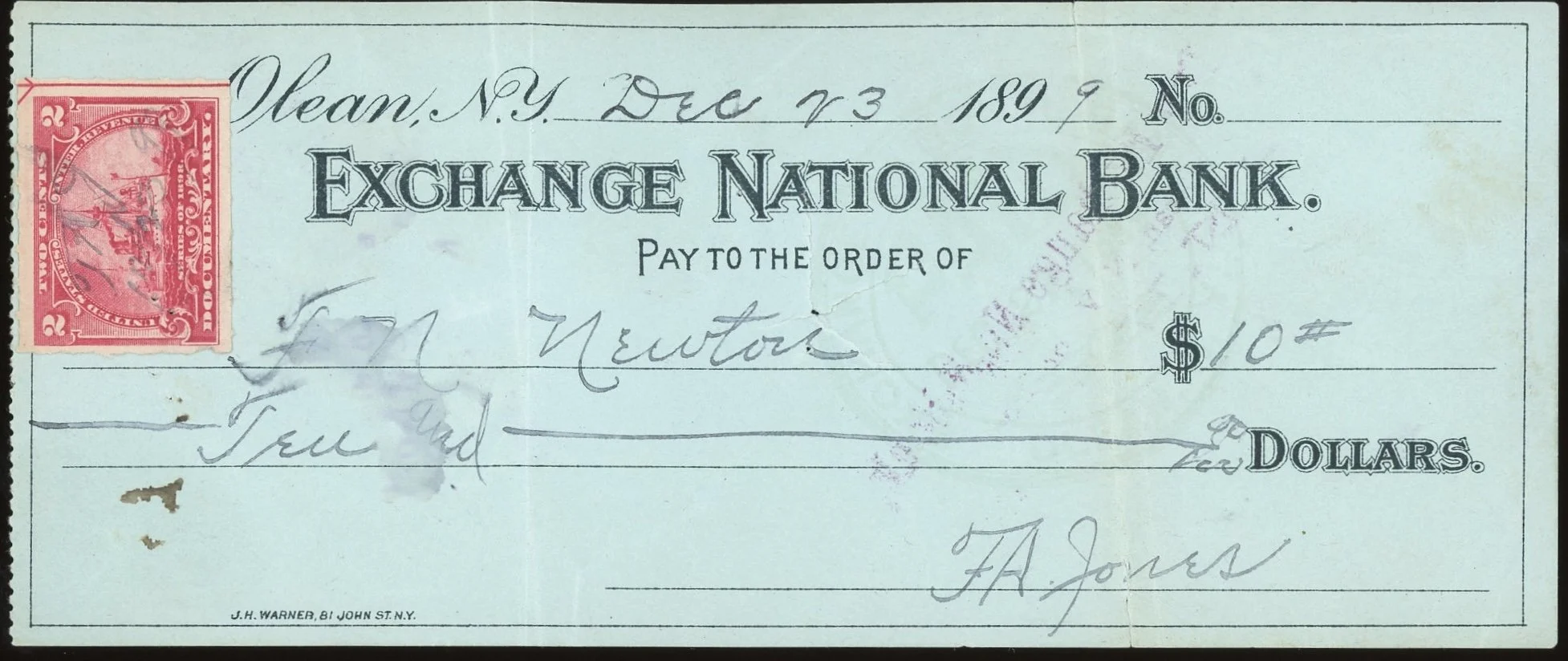
THE BLUE CHECK
Signed on December 23, 1899, this check was written on high-end, custom-printed stationery. The printer is identified in small letters on the face of the check as “J.H. Warner, 81 John St. N.Y.” J.H. Warner was a well-known commercial stationer and lithographer located in the heart of New York City’s Financial District just a few blocks from Wall Street. In 1899, a local bank in Olean or Shinglehouse would not normally outsource their standard checkbooks to a high-end Manhattan printer. This was likely a custom order for Jones. Since he played for the Brooklyn Superbas, he spent his summers in New York City. He likely had these checks made at a premium shop near the ballpark or the team’s offices to use for his more formal business. It also provided a subtle way to show local vendors in Pennsylvania that he was a man of the world with New York City connections.
Although it is impossible to confirm today, this $10.00 check to F.N. Newton was likely an effort to close out the books for the 19th century. Frank N. Newton was a prominent figure in Shinglehouse, PA, serving as a local merchant, a leading member of the Methodist church, and a public official (Prothonotary of Potter County). In 1899, Newton likely provided a number of essential supplies for Jones’ retail business. $10 in 1899 was worth about $380 in today’s purchasing power. This check may have settled his Christmas accounts by paying for standard dry goods, hardware, or holiday groceries. December 23, 1899, was a Saturday, so Jones’ store would have been packed with locals from Shinglehouse and Bolivar doing their final holiday shopping. He likely took his Saturday night earnings and wrote this check to clear his debts before the Christmas holiday.
Business owners like Jones and Newton likely traded with each other on a regular basis. And Jones’ check showed he was a hands-on owner. He did not just sign the check; he took the time to personally affix and initial the revenue stamp. He seemed to understand the value of a dollar and the importance of a well-run ledger. Given his skill at business management, it is not surprising he would soon prove to be a successful field manager for the White Sox.
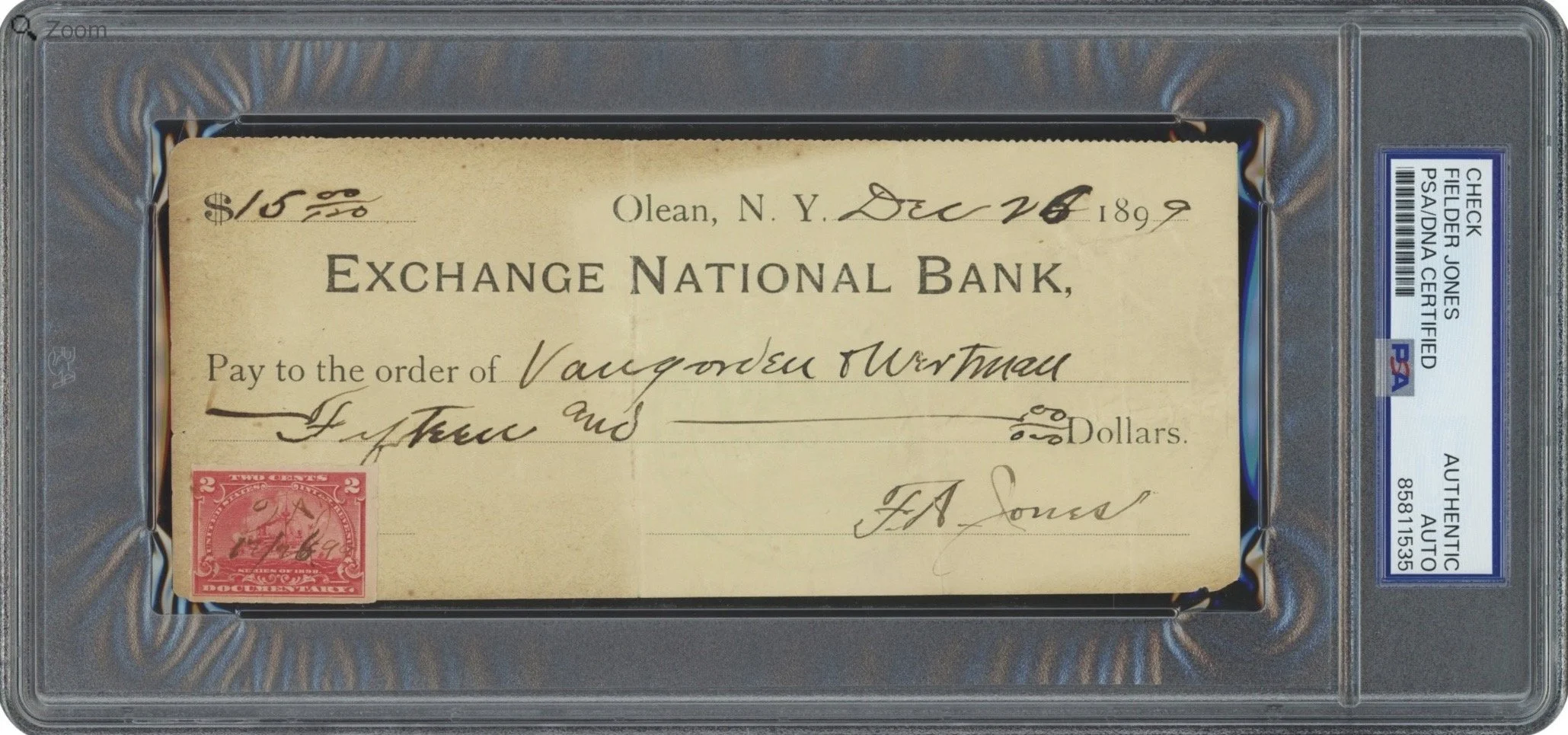
THE BROWN CHECK
If the blue check reflects the professional, high-end side of Jones’ life, then the brown check shows the local, salt-of-the-earth business side. A commercial stationer or lithographer does not appear to have been involved in the production of this check. As such, and given the lesser quality paper evident from the browning and brittle edges and corners, the brown check was quite likely a standard over-the-counter document from the Exchange National Bank of Olean, perhaps kept behind the counter of his Bolivar store for daily transactions. By December 26, he was helping folks prepare for the “Party of the Century.” The day after Christmas, Jones had turned his attention to the upcoming New Year’s celebration. He wrote a $15 check to Van Gorden & Wertman, a cigar manufacturing firm based in Shinglehouse, PA. At the turn of the century, Shinglehouse was a booming town due to the discovery of natural gas, and the cigar industry flourished there. Van Gorden & Wertman were major local employers, producing thousands of cigars on a weekly basis.
While $15 might seem like a small amount now, in 1899 it was a substantial sum akin to $550 or $600 today. At wholesale rates, $15 would have purchased roughly 500 to 600 “nickel” cigars. If you were handing that over to a cigar company, you were not just picking up a quick pack of smokes; you were likely making a bulk purchase of a luxury product. This bulk order was almost certainly a restock for his store’s cigar case, ensuring local revelers had plenty of tobacco for the legendary parties planned for December 31, 1899. Tobacco was the social glue of the 1890s. While the champagne flowed, the cigars were the status symbol. If you were hosting a gala at a hotel or a private club, $15 worth of cigars (300 standard or 100-150 premium) would be the expected “party favors” for a room full of gentlemen in evening dress.
The fact that Jones spent 50% more on cigars than on his other expenses just three days later suggests that tobacco was a high-priority, high-volume seller in anticipation of the biggest New Year’s Eve party in 100 years. Perhaps Jones had sold a lot of tobacco over Christmas and now realized he needed a fresh restock from Van Gorden & Wertman to get through the end-of-century parties. In this respect, Jones’ $15 purchase on December 26, 1899, probably was not just a personal purchase. This would probably have been a restocking order for a general store preparing for New Year’s Eve festivities – perhaps a 100-count box of premium, hand-rolled Cuban-leaf cigars, packaged in a polished Boîte Nature (wood) box. As a key figure on the pennant-winning Brooklyn team, it is fun to imagine Jones instead buying a high-end “cabinet” of cigars to send back to his teammates or manager Ned Hanlon as a celebratory end-of-century gift. Whether it was through his general store or his social commitments, Jones was making sure he had his bases covered for New Year’s Eve revelry.
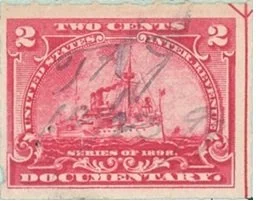
2c BATTLESHIP REVENUE STAMP INITIALED F.A.J. (“Fielder Allison Jones”)
Both checks feature a 2-cent “Battleship” revenue stamp affixed to the front. The stamp itself is a relic of the Spanish-American War. To fund the war, the U.S. government passed the War Revenue Act of 1898, which required a documentary internal revenue stamp on various financial papers, including bank checks. From July 1, 1898, to June 30, 1901, every check written in the United States was required to include a 2-cent revenue stamp to help pay off the debts from the conflict in Cuba and the Philippines. Because the Spanish-American War was famously sparked by the sinking of the USS Maine in Havana Harbor, the government chose to feature a battleship on the stamp. The person writing the check would hand-cancel it with ink. Here you can see that Jones wrote his initials (“F.A.J.”) on the face of each stamp and included the date. These hand-cancellations are a “gold standard” for authenticity. They prove that Fielder Jones himself – not a bank clerk or his spouse – personally licked the stamp, pressed it to the paper, and initialed it. In other words, Jones provided two signatures – albeit one full, and one initialed – on each check. Seeing the same signature and initials twice across two different dates shows how Jones consistently completed his business.
* * *
Although Jones is often remembered as the stoic, brilliant manager of the “Hitless Wonders,” these checks reveal the man before the manager. In December 1899, he was just a 28-year-old outfielder and a small-town businessman trying to make sure his 2-cent taxes were paid and his cigar supplies were available. Together, these two checks represent a sort of “Fielder Jones Holiday Archive.” They capture a world-class athlete at a pivotal moment in American history, managing his off-season business and participating in wartime economics. For those who collect Deadball Era memorabilia, these two checks are not just financial records; they are the physical proof of a man who understood the value of a dollar and the importance of a well-stocked humidor at the turn of the century. Because he died in 1934, his autograph is extraordinarily scarce. Finding two checks signed by the man — who also licked, attached, and initialed the stamps on them — over 125 years ago is truly incredible. The hobby owes a debt to the collectors who preserved and paid them forward to allow us to enjoy them so much more now than when they were signed by F.A. Jones during the final days of the 19th century.
1906 WORLD SERIES
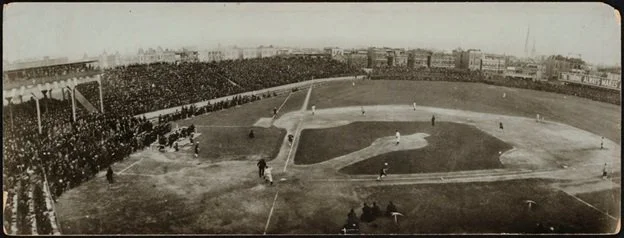
This picture was taken during the 1906 World Series at the West Side Grounds, home of the powerhouse Chicago Cubs, which team had won 116 regular season games. In this panoramic photo, the White Sox have the ball in play with the bases loaded. Despite the White Sox living up to their “Hitless Wonders” reputation by batting .198 as a team in the Series, Fielder Jones successfully managed them to an improbable World Series victory.